
The CAM opined that it might not be 'legal' and it would have to be looked into, still waiting for that. Individual billing was in place, set up by the Developer and used for 3 years. Why it would suddenly not be legal dosen't compute, nothing further has been done in this regard and it is very disappointing.
I do understand that the Developer controlled BOD was so useless that you wouldn't really expect them to actually 'do something', but I had hopes that once the Board came under the control of the Owners (we now have 2 of 3 positions) that we would finally be in a position to make some changes.
Clearly we need to get an Owner controlled Board of Directors that is prepared to make some decisions, particularly if we can save Owners several hundred dollars a year. Here is the original post FYI:
Owners 'might' save $400-500 a year on Quarterly dues!*
We need to look into hiring another utility managing firm to bill units individually. There are many such firms, below is some information from one out of Sarasota. You will recall that we had quarterly dues of $537 which went up to $675 quarterly to cover water/sewer costs when AUM was fired as our billing firm 2 years ago.
I believe we can substantially reduce our quarterly payments by returning to what is called 'co-metering', where each unit pays its own water usage. I don't know that we can return to exactly $537 quarterly, but we can almost certainly get it back to the mid $500 area.
* Keep in mind that while 'dues' are reduced you will also gain a monthly bill for what water you use, but you should still save $ overall with this change.
For details on this firm see: http://web.amsbilling.com/WebUBS/index.php?hidAction=welcome
This potential savings for owners needs to be looked into by the BOD.



Something to think about:
The 2010 Budget reflects $34,800 for Water and $29,700 for Sewer (total: $64,500), this comes out at an actual cost of $383 per unit yearly. When AUM left their quarterly billings to owners ceased and we went instead to an increased dues payment to cover the estimated water/sewer costs. Quarterly dues increased from $537 to $675 to cover the water/sewer city charges. This is a yearly increase in dues of $552 from the prior yearly dues.

We no longer get any quarterly water/sewer bills from AUM, our water/sewer is now incorporated into our quarterly payment of $675. Every unit pays the same no matter how much usage there is for water, a 4/3 with 8 people pays the same as an unoccupied unit with no usage. In doing the math each unit is paying $169 yearly more than the actual costs of water/sewer, or a gain/profit for the Association of $28,000 yearly.
As we have seen here at NCC sub-metering can be effectively employed in condominiums, however the choice of a reliable firm to accomplish this is needed. AUM had 67 complaints with the BBB over 36 months, another billing firm out of Sarasota that I looked at had only 5 in the same period. Clearly sub-metering will decrease what we now pay for water and one benefit for most owners is that those using the most water will pay the most, not the case as things are now, where the total billing is simply divided by 168. One firm that might be considered is: AMS Billing at: http://www.amsbilling.com/main/home.sfx?session=%{Session}% .
So we have something to think about:
1) Should we get a year end rebate for that $169 yearly water overcharge?*
2) Should we go back to metered unit billing where each unit pays only for the water used by that unit? (Obviously we would not use AUM but contract out to another utility billing firm.)
If we were to hire another utility billing firm we would pick up another bill every quarter, but we should also have a yearly drop of approx. $550 in our Association dues payments, plus you would not be subsidizing those units with more water usage
.----------------------------------------------
* The sewer charge remains constant, equally divided between 168 units, only water costs fluctuate.
Update: Some general information from a Florida utility billing firm I contacted regarding going back to the metering system:
The current meters can probably be used with this firms computers and billing system, they might not be used if AUM had some off brand meters put in initially but it is probable that the ones in place can be used, a contract of 3 years is standard but prices can be locked in with a longer 5 year contract, billings to individual units can be monthly or quarterly, the fee to the unit is $10 per billing period, past due fees can be applied and the amounts charged are up to the condo – a fee split is possible to the condo could make a few dollars on past due payments, meter info is gathered and forwarded to them via a dedicated phone line. They use both inhouse technicans/installers and also can contract with local firms as needed.
===========================
(photo) Meter is an ‘AMCO INSIDER’ Model C700 ¾” B
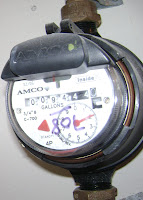 Made by:
S/N 16037471
FA5230 FCC ID: HCQ306ABB
 Made by:
Inovonics Corp, of Louisville , CO. 80027

